

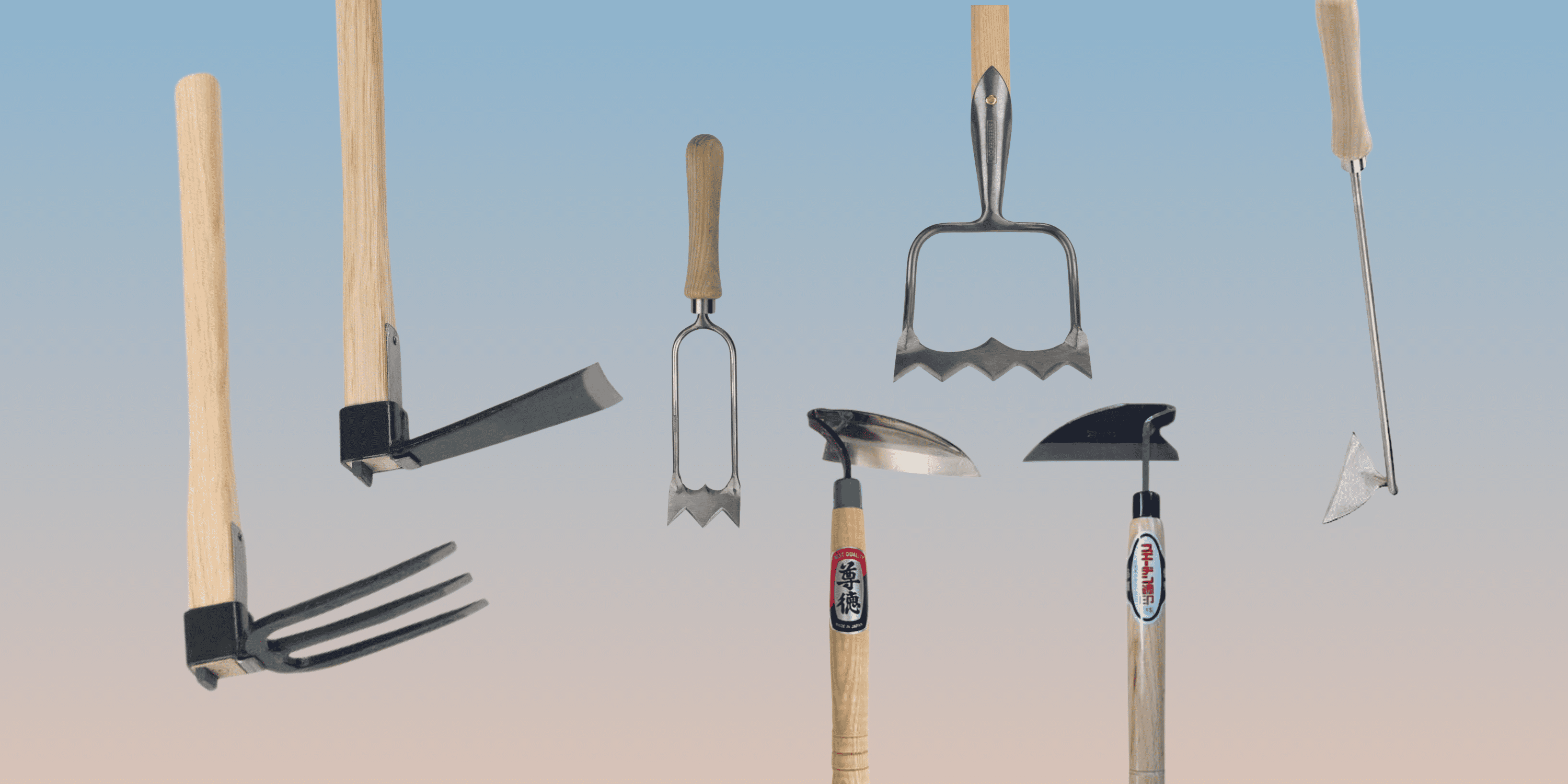
Three blade styles, three motions, three different ideas about how you remove a weed. Worth understanding if you want to stop buying the wrong hoe.
The Nejiri Gama
The Japanese answer, and a completely different philosophy. Nejiri means twisted, gama means sickle, and the nejiri gama is a small, light, one-handed hand hoe with a sharp angled blade designed for the kind of close, precise work you do on your hands and knees. It comes out of centuries of Japanese smithing tradition, particularly in Sanjō (Niigata Prefecture) and Miki (Hyogo Prefecture), two towns that have been forging blades since the Edo period. Sanjō’s smithing grew up around rice farming and locally smelted iron. Miki traces its tradition back to the 16th century, after the rebuilding of Miki castle drew swordsmiths and toolmakers to the area. Both towns still produce hand hoes in family workshops where the technique has been passed down for generations. The blade keeps an edge mass-produced hoes simply cannot, and you can feel the difference the first time you weed a bed with one.
In the bugg® range, the Matsuo Hamono Garden Hoe is the right-hander’s pick, forged in Sanjō. The Maruyoshi Garden Hoe is the left-hander’s. Both are nejiri-style angled hand hoes built for the same surgical work.
The Draw Hoe
The oldest hoe in the world, more or less. Versions of it turn up in Egyptian wall paintings, Mesopotamian agriculture, and every civilisation that has ever planted a row of anything. The blade is flat, rectangular, heavy, and set at 90 degrees to the shaft, which is the geometry you want when you are chopping down into hard ground and pulling earth back towards you. This is the hoe for hilling potatoes, dragging soil into trenches around your leeks, and breaking up sod where nothing has grown for a while. The motion is downward and back: chop, drag, repeat. It is brute work, and the draw hoe has been doing it for roughly six thousand years.
In the bugg® range, the Elephant Tools Hand Hoe and Forked Hand Hoe are the draw hoes. Both forged in Miki, Japan, one with a flat carbon steel blade for slicing weeds at the root, the other with prongs for tearing up compacted soil. Same workshop, two shapes, depending on what your soil is asking for.
The Dutch Hoe
A much younger invention, born out of the Dutch Golden Age in the 1600s, when the Netherlands was busy inventing modern horticulture alongside most of the Western art canon. The blade is open and flat, set in line with the shaft rather than at right angles, and you push it forward just under the soil surface, slicing weeds off at the root level before they know what hit them. The point of the Dutch hoe is that you can cover ground at speed without bending over, and the weeds you cut sit on top of the bed instead of being buried back into it. Sneeboer has been hand-forging these in the Netherlands since 1913. Their Royal Dutch Hoe, designed in collaboration with English rose breeder John Scarman, won Garden Product of the Year at the RHS Chelsea Flower Show, which is a fairly serious credential.
Sneeboer also makes a smaller, hand-sized version, the Royal Dutch Hand Hoe, for the close work where a 155cm handle would be overkill.
Which one do you actually need?
Probably more than one. The draw hoe for the heavy soil prep work in the vegetable garden. The Dutch hoe for the big borders and the weekly walk-through that keeps the beds tidy. The nejiri gama for the close work between seedlings and around precious plants. Different jobs, different blades, different motions. The trick is knowing which one your soil is asking for.
bugg® stocks all three at Hoes & Cultivators.


