

There is a point in every garden where secateurs feel like bringing a teaspoon to a flood. The flax has tripled. The ornamental grasses have gone feral. The perennials you meant to cut back in autumn are still standing there, judging you.
This is sickle territory. A good Japanese sickle clears in one pull what would take forty snips, and it is one of the most satisfying tools you will ever own. Here is how to pick the right one.
What a sickle is for
A sickle is a curved blade on a handle, made for soft and fibrous growth: flax, grasses, herbaceous perennials, herbs and weeds. You gather a handful with one hand and pull the blade through with the other. That is the whole technique, and it is oddly addictive.
What a sickle is not is a saw. Serrated sickles in particular are made for fibre, not wood. Point one at a woody branch and you will damage the blade. For branches, you want a pruning saw.
Our sickles at a glance
| Sickle | Blade | Weight | Best for | Price |
|---|---|---|---|---|
| Hounen Flax Sickle | Serrated high carbon steel | 90g | Flax, herbs and soft stems. Not a wood saw, please | $32.90 |
| Niwaki Mini Sickle | Single bevel carbon steel, right handed | 80g | Weeds between the pavers and the morning asparagus | $44.00 |
| Niwaki Herbaceous Sickle | Serrated carbon steel | 82g | Flax, grasses and general herbaceous chaos | $46.00 |
| Okatsune Garden Sickle 405 | 150mm curved Japanese steel, 2.0mm thick | 182g | When the weeds stop being a nuisance and become an adversary | $48.90 |
The four, in a little more detail
Hounen Flax Sickle
The one most New Zealand gardens need first. Japanese high carbon steel, a serrated edge that works on the pull stroke, and a back bar along the spine for strength. At 90g you barely notice it in your hand. It is made for flax, herbs and soft stems, and it goes through them like it has somewhere else to be. The sheath is sold separately, or you can get both together in the Flax Sickle & Sheath bundle and save 10%.
Niwaki Herbaceous Sickle
Tradition with a twist. This shape was originally designed for harvesting rice in Japan, and it turns out that what works on rice works beautifully on flax, ornamental grasses and the general herbaceous chaos of a late season border. Serrated carbon steel, 82g, and it comes with a vinyl sheath. Grab a handful, pull, and enjoy the clean release.
Niwaki Mini Sickle
Small, sharp and built for the detail work. The single bevel carbon steel blade is the right size for lifting weeds out from between pavers and for harvesting asparagus spears cleanly at the base. It weighs 80g and comes with a vinyl sheath. One thing to know before you buy: it is made for right handers.
Okatsune Garden Sickle 405
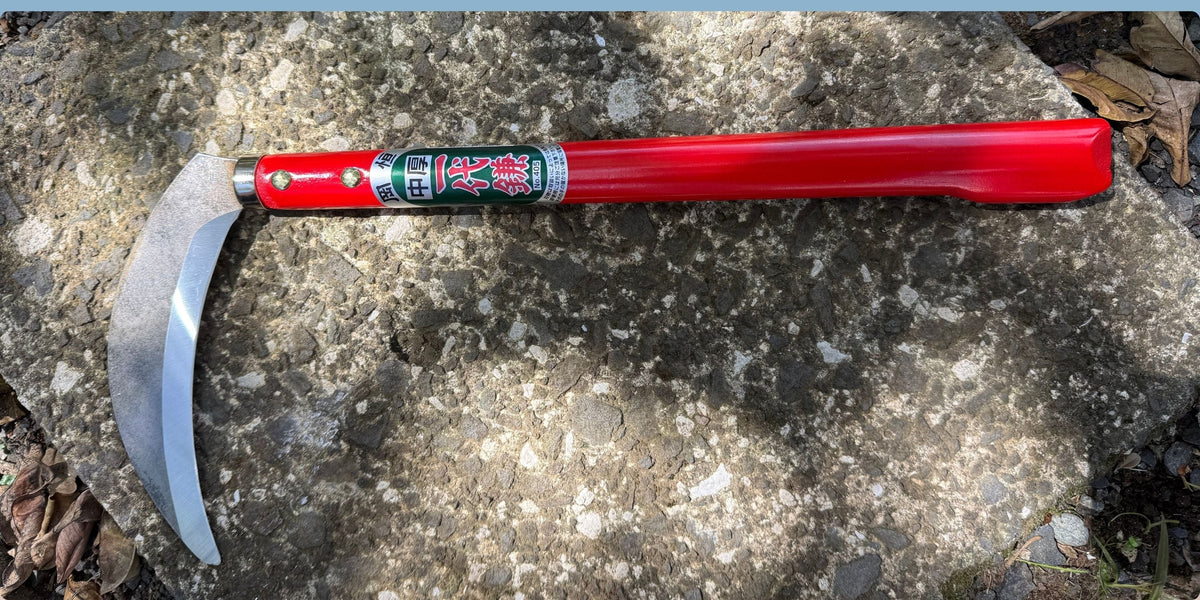
Mr Reliability, in sickle form. Forged in Hiroshima, with a 150mm curved blade a solid 2.0mm thick on a long 335mm handle. That handle gives you reach and leverage, which is what you want when you are reclaiming ground from flax, overgrown perennials or long grass. At 182g it is the heavyweight of the group, in the best way.
How to choose
- Mostly flax and soft stems: Hounen Flax Sickle.
- Grasses and perennials to cut back each year: Niwaki Herbaceous Sickle.
- Paving, edges and the vege bed: Niwaki Mini Sickle.
- Big areas, long grass, or you want more reach: Okatsune Garden Sickle 405.
How to use one properly
- Pull, don't hack. Gather the growth in one hand, set the blade behind it and draw it through in one smooth stroke.
- Cut on the diagonal. Slicing across the fibres at an angle is easier on the blade and cleaner for the plant.
- Mind your other hand. Keep the hand holding the foliage well above the blade, and keep your legs and body out of the blade's path.
- Keep it to plants. Wire, stones, plastic ties and wood will chip a good Japanese edge.
A note on cutting flax
If you are tidying harakeke, the traditional practice is worth following. Leave the central new shoot and the leaf on either side of it, and take only the outer leaves. Cut each one low on a downward angle, sloping away from the centre of the plant, so water runs off instead of sitting in the base. The plant stays healthy and so does the fan.
Looking after it
These are carbon steel blades, so they reward a small ritual. Wipe off sap and dirt when you finish, using a Crean Mate for anything stubborn. Dry the blade, give it a thin wipe of camellia oil, and put it back in its sheath. Two minutes, and it will be just as sharp next season. You will find everything you need in Care and Maintenance.
Browse the full range in Saws and Sickles.


