

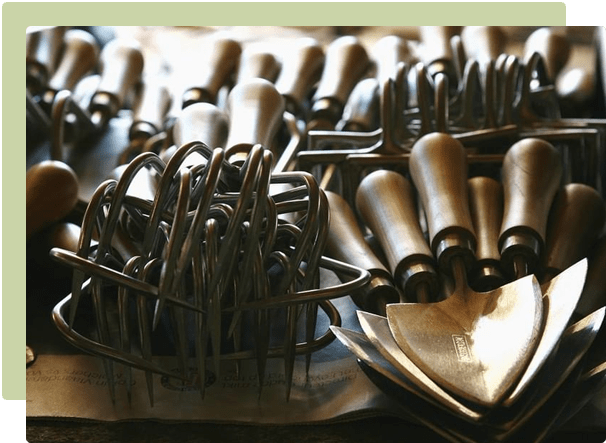

Arie Sneeboer had a line he liked to use: anyone who has held a Sneeboer in their hands never wants anything else. It is a bold claim from a man who started in a garden shed. It is also, more than a century later, still annoyingly true. Fair warning: one Sneeboer tends to become several.

Over a hundred years at the fire
In 1913, in Bovenkarspel in the north of Holland, Arie Sneeboer set up a small forge to make tools for the local growers and market gardeners. His pitch was simple. The tools on offer were not good enough, and he knew how to do it better. The growers agreed, word travelled, and the shed became a factory.
The company is still owned and run by the Sneeboer family, three generations in, with the fourth ready to take it on. In 2013, a hundred years after the first fire was lit, the Dutch royal household named Sneeboer an official purveyor, so the tools now carry the title Royal Sneeboer. That is granted, not bought. We wrote about it in Tools with Titles.
How they are made
The Sneeboer factory runs two forges, and both still burn coal, because the family maintain it is the most effective way to heat steel for forging. Four fires, four anvils, one for each. The steel is worked by drop hammer and by hand, and the oldest hammer on the floor was made in 1920 and is still in use.


The methods developed a hundred years ago are the methods used now, which is why each new member of staff is trained in house by Sneeboer themselves. It takes up to three years, because traditional blacksmithing is not something you can learn anywhere else anymore. Buying a Sneeboer is, in a quiet way, keeping that trade alive.
What hand forging gets you is steel that has been worked rather than stamped. It takes a keener edge, holds it longer, and is paired with an ash handle fitted to last decades.
Three to meet first
We carry over sixty Sneeboer tools. If you are starting a collection, and you will be, these are the three everyone ends up with.

Royal Dutch Hoe. Developed with English rose breeder John Scarman, and named RHS Chelsea Garden Product of the Year in 2013. You work it walking backwards, which leaves a fine tilth with no footprints and means you are not replanting weeds with your boots.
Planting Trowel, Old Dutch Style. Sharp rounded sides and a pointed tip that cuts through soil rather than shoving it aside. Bulbs, seedlings, dividing perennials, all of it. Monty Don has called it his favourite tool, and he has tried a few.

Wrotter. A traditional Dutch weeder with a precisely angled head that slides in beside established plants and lifts deep and tap rooted weeds out whole. The name is old Dutch for tough worker, which is the whole product description really.
Keeping them for the next generation
Tools built to be inherited need about ten minutes of care a few times a year. Clean, sharpen, oil, store. We have written the whole ritual up in Care for Your Tools, and They'll Care for Your Garden, and the Sneeboer Tool Sharpening Kit has everything in one box.
Next time you reach for your Sneeboer, remember there is a coal fire in Bovenkarspel and a hammer older than your grandparents behind every one. Premium products for people who live in the garden.


