

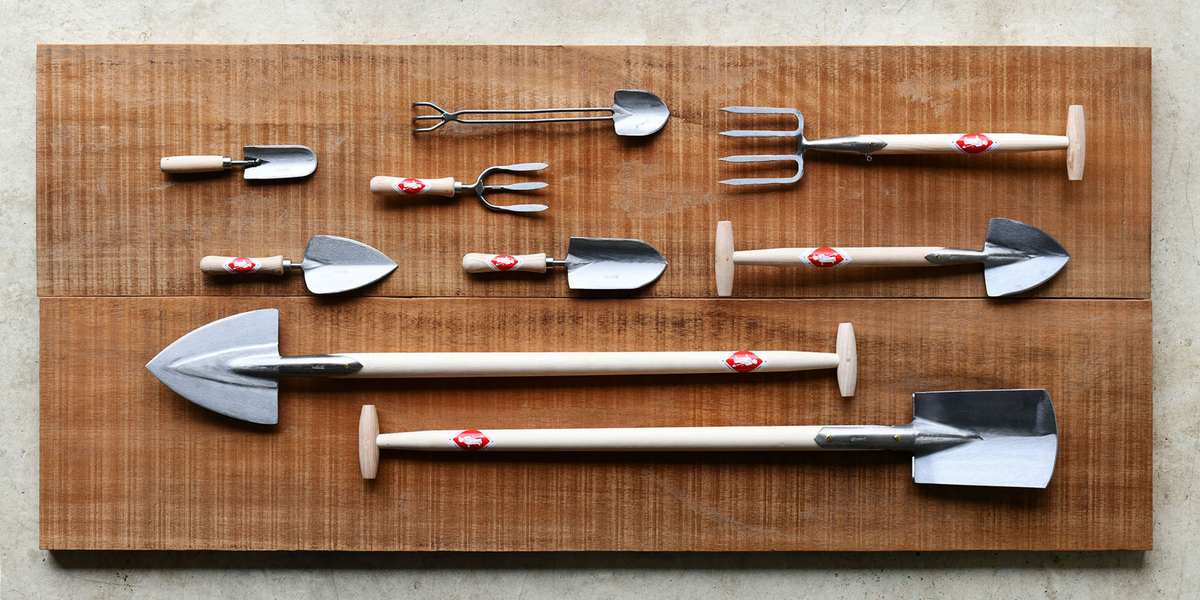
Some garden tools have model numbers. A few have titles. It is one of the quiet pleasures of stocking the good stuff that two of the makers on our shelves carry honours most brands could not buy with any marketing budget: one is an official purveyor to a royal household, and the other has been working steel since before anyone had heard of a Rolls or a Royce. Neither fact makes a hole any easier to dig. Both tell you exactly how these tools will still be working when they are somebody's inheritance.
Royal Sneeboer, by appointment
In the Dutch village of Bovenkarspel, the Sneeboer family has been hand-forging garden tools since 1913. Same family, same methods, four generations of people heating steel and hammering it into spades that get passed down rather than replaced. That alone would earn them a place on our shelves.
Then in 2013, a century in, the Dutch royal household made it official: Sneeboer was named a royal purveyor, and the company has carried the name Royal Sneeboer ever since. This is not a marketing partnership. Purveyor titles are granted, not bought, and they recognise a supplier the royal household actually uses. The connection is personal, too: back in 2003, the man who is now King Willem-Alexander planted bulbs at Keukenhof with a Sneeboer Plant Trowel, at a ceremony for a new bulb variety named in his honour.
So when we say the Sneeboer Large Spade with Steps or the Perennial Spade is the aristocracy of the tool shed, we are not reaching for a metaphor. There is a palace in the Netherlands that agrees.
What does hand-forged actually get you? Steel that is worked, not stamped, which means an edge that sharpens keener and holds longer. Ash handles fitted to last decades. And the small, humane details that only come from people who garden themselves: the fold of steel atop the Large Spade's blade so your boot pushes on metal instead of the spade cutting into your instep. Every tool is made to order by a small team, which is why our restocks take patience, and why the tools are worth it.
Browse the full range in our Sneeboer collection.
Sheffield steel, since 1730
The other titled house on our shelves is Burgon & Ball, who began working steel in Sheffield in 1730. To put that in perspective: they had been making tools for 174 years when the first Rolls-Royce was built, and for over a century before New Zealand signed the Treaty. Since 1873 they have worked out of La Plata Works at Malin Bridge, and in 2012 their stainless tool range earned the endorsement of the Royal Horticultural Society, the closest thing gardening has to a peerage of its own.
Our pick of their range is the honest one: the Digging Spade in Boron Green, boron steel from the city that taught the world what good steel means, priced for people who dig rather than collect.
Why titles matter (and why they mostly don't)
Here is the truth about royal warrants and purveyor titles: they will not dig your holes, and a title on the maker does not excuse a tool that is wrong for your hands or your soil. What a title does is answer the one question you cannot test in the shop: what is this thing like after ten years? Institutions that have gardened continuously for centuries do not keep buying from suppliers whose tools fail. A purveyor title is a review written across generations.
Which is the whole idea behind this shop. Buy once. Buy well. The Dutch royal household simply got there before we did.
The kit
- Large Spade with Steps, Sneeboer, $268.00
- Perennial Spade T-Handle, Sneeboer, $138.00
- Border Spade, Sneeboer, $290.00
- Digging Spade Boron Green, Burgon & Ball, $139.00
- Or the whole family: the Sneeboer collection
Buy once. Buy well.


